
Overview
Measuring resilience accurately is a complex undertaking. The science behind it spans health psychology, occupational wellbeing, and behavioral research, and translating that into a digital tool that is both rigorous and accessible requires careful engineering. We built myRQi.com, a secure e-learning and psychometric platform for Kirros Consulting, on Drupal. The platform allows users to complete the Resilience Quotient Inventory questionnaire online, processes their responses through a sophisticated multi-scale scoring engine, and generates a personalized 26-page report complete with charts and tailored commentary. The result is a platform that turns psychometric science into something individuals and practitioners can actually work with.
About the Client
Kirros Consulting is a UK-based global consultancy specializing in employee wellbeing, resilience, and performance. Founded by Dr. Matthew Critchlow, who also serves as a Visiting Lecturer at the University of Westminster, the company developed the Resilience Quotient Inventory in collaboration with leading experts in health psychology. Their products and services have reached over 10,000 people across 32 countries, with clients including Microsoft, Johnson and Johnson, the British Medical Journal, Nationwide Building Society, the Department for Work and Pensions, HM Revenue and Customs, and Imperial College London. The RQi is the flagship psychometric tool in their portfolio, alongside the ORGRPQ organizational questionnaire and the e360-Audit physical environment assessment.
Goals
Kirros needed a secure, professional online portal where individuals and practitioners could administer the RQi questionnaire and receive their results without any manual processing by the Kirros team. The platform needed to handle the complete user journey from account creation and questionnaire completion through to report generation and e-learning resource access. For practitioners, the portal also needed to serve as a white-label administration environment where they could manage questionnaires and distribute reports to their own clients. The system had to feel polished and trustworthy, reflecting the scientific credibility of the tool itself.
Challenges
The scoring logic behind the RQi is the most technically demanding part of the platform. The inventory is structured around six composite elements of resilience, each broken down into sub-scales, giving the tool 26 sub-scales in total alongside seven composite scores. Each response feeds into multiple calculations, the scores need to be normalized against a reference population, and the output has to be interpreted through a predefined framework that maps score ranges to specific commentary and recommendations. Getting all of this right, and doing it consistently across thousands of users, required building a robust and carefully tested calculation engine rather than a simple form processor.
Report generation added another layer of complexity. The 26-page output is not a static template. It is a dynamic document where every chart, every commentary block, and every recommendation is driven by the individual’s specific score profile. Different score combinations produce different narrative outputs, and the charts need to accurately reflect where the user sits relative to the population norms. Producing this as a downloadable, professionally formatted document from dynamic data required careful work on both the calculation layer and the PDF rendering layer.
The platform also needed to support two distinct types of users with different needs. Individual users complete their own questionnaire and receive their own report. Certified practitioners, who go through a separate three-day accreditation process, need to administer questionnaires on behalf of clients, access team-level reporting, and have their own branded area within the portal. Managing these different roles and access levels cleanly was an important part of the overall build.
Solutions
We built the platform on Drupal, using its content management and user management capabilities as the foundation while building the questionnaire engine, scoring system, and report generator as custom functionality on top.
The questionnaire is delivered as a secure online form requiring authenticated access. Once a user completes and submits their responses, the scoring engine processes each answer through the RQi’s calculation framework, computing scores across all 26 sub-scales and rolling them up into the seven composite scales. Each score is then evaluated against the reference population data to produce a normalized result that places the user in context relative to the broader population sample.
The report generation engine takes the full score profile and builds the 26-page RQi Client Report dynamically. Score ranges map to specific commentary blocks, so a user with a lower score on a particular sub-scale receives targeted guidance relevant to that area rather than generic content. Charts are generated to visually represent the user’s scores across the six elements and their sub-scales, giving both users and their practitioners a clear visual summary of the profile at a glance. The completed report is rendered as a downloadable PDF and made available through the user’s secure account.
The practitioner layer gives accredited RQi Practitioners their own administration space within the portal. Practitioners can set up questionnaire access for their clients, monitor completion status, and distribute reports without the Kirros team needing to be involved in the process. This scales the tool’s reach without creating operational overhead for Kirros.
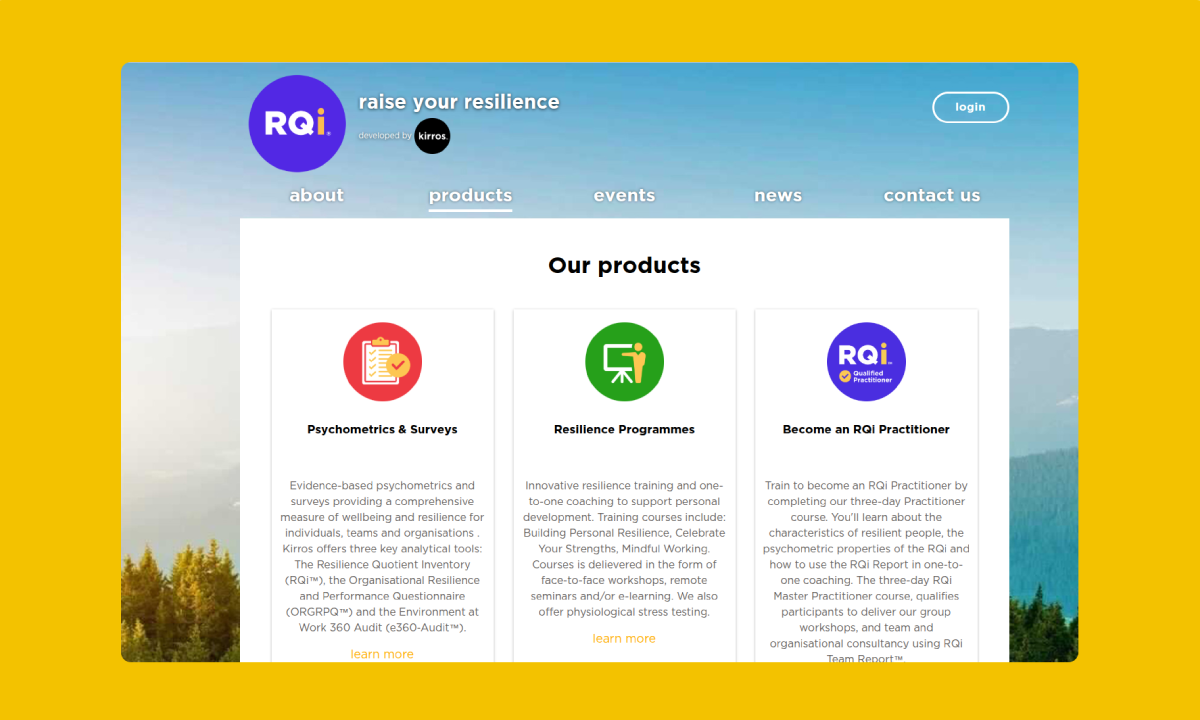
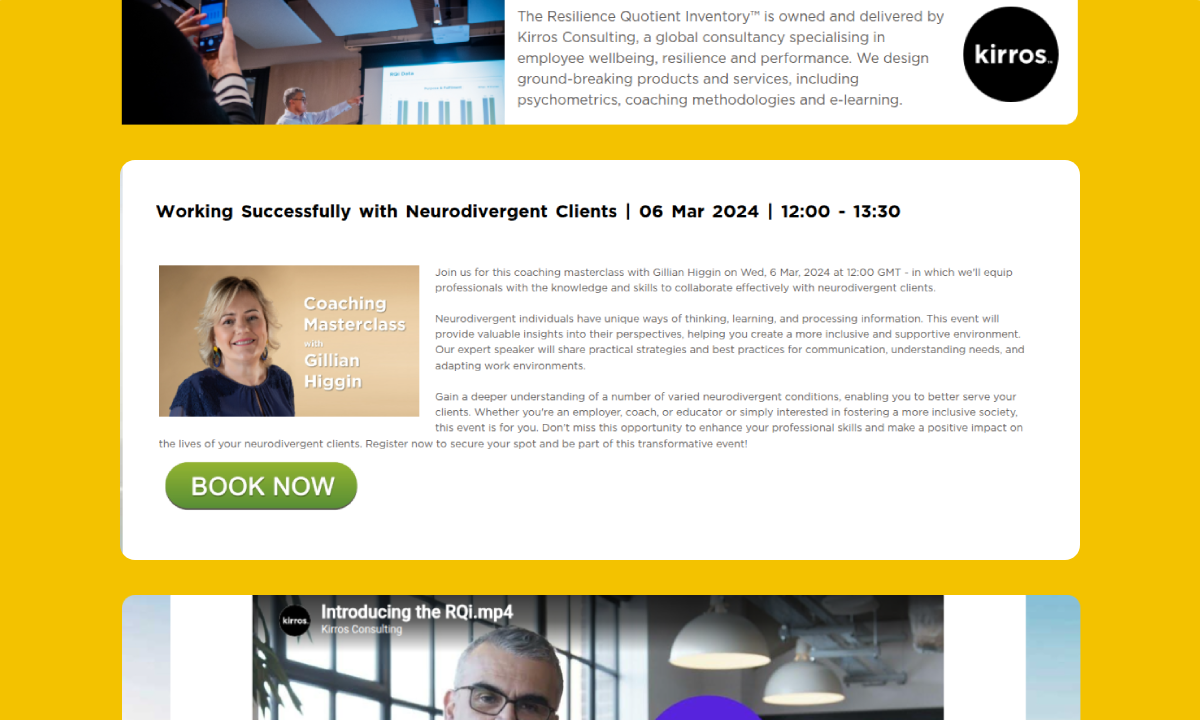
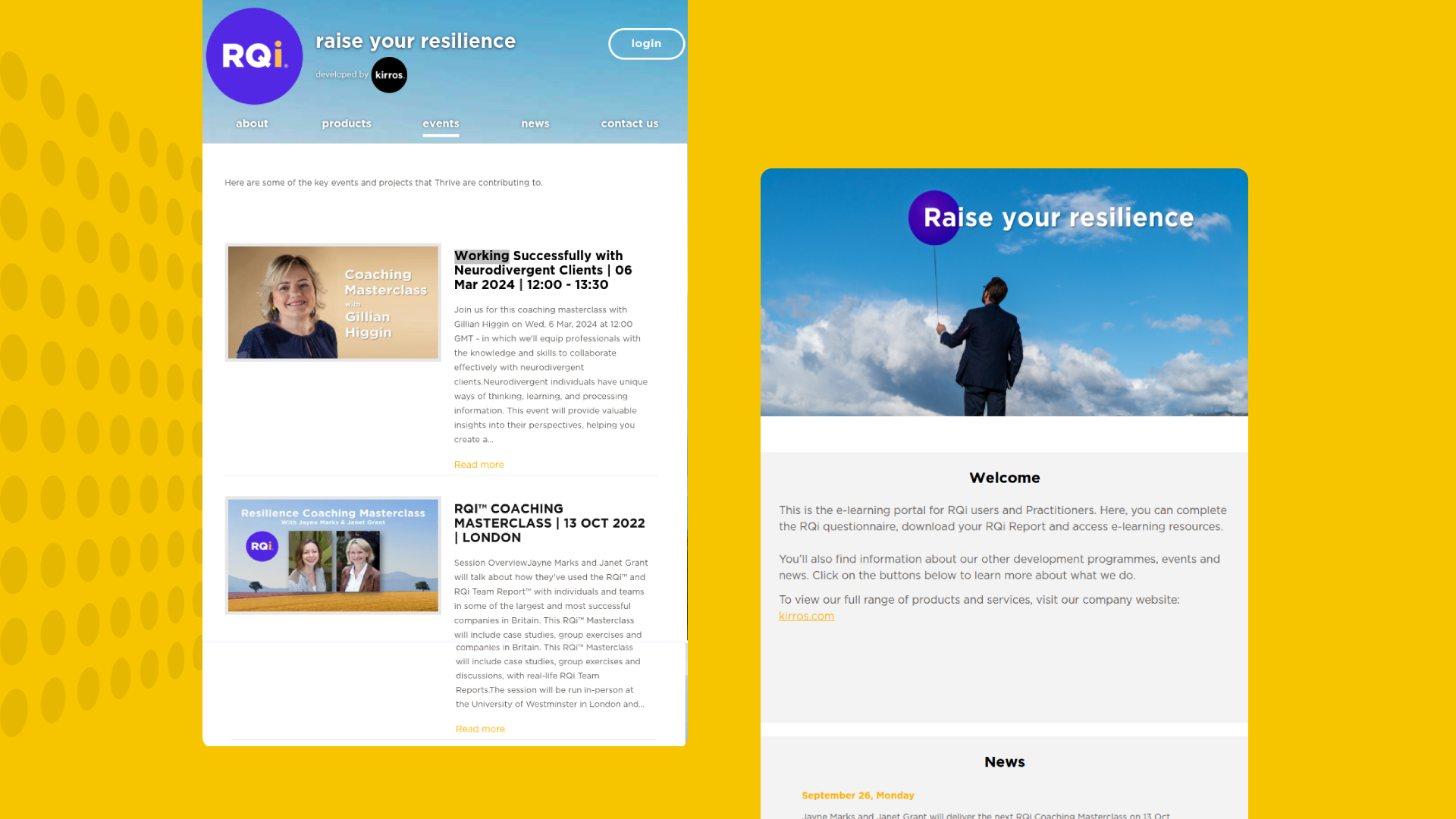
The portal also serves as the access point for e-learning resources that complement the questionnaire, giving users ongoing support for developing the resilience areas identified in their report. Events, news, and programme information round out the platform as a central hub for everything RQi-related.
Results
Kirros now has a platform that delivers the full RQi experience end to end without manual intervention. Users receive a professionally formatted, scientifically grounded personal report immediately after completing the questionnaire, with charts and commentary that speak directly to their individual score profile. Practitioners can manage their own client populations through the portal independently, which has allowed Kirros to grow their practitioner network without a corresponding increase in administrative workload. The platform supports Kirros’s global reach across 32 countries, handling questionnaire completion and report delivery consistently regardless of where the user is based.